Trump Ignored Decades of Warnings on Iran War Economic Impact
President Trump on Monday seemed shocked—shocked!—at the rapidly growing economic fallout from his war on Iran. U.S. gasoline prices spiked and markets wobbled as Saudi Arabia, Qatar, Bahrain, the UAE and Iraq announced steeps cut backs on oil and natural gas production. With the Straits of Hormuz effectively closed, France dispatched warships to the region even as the G7 nations discussed tapping their strategic petroleum reserves. In response, Trump could only claim his military campaign was “very complete” and the war would be over “very soon.” As CNN reported:
The Trump administration has started to panic about the spiking price of oil.
While senior Trump aides had anticipated some brief surge in oil prices in the first days of the war with Iran, the size and sustainability of the market reaction caught them off guard, people familiar with the internal discussions told CNN.
But if Trump and his allies were caught “off guard,” they shouldn’t have been. As it turns out, 25 years of Iran war games and conflict assessments offered dire predictions of the grave economic consequences of American and/or Israeli conflict with Iran.
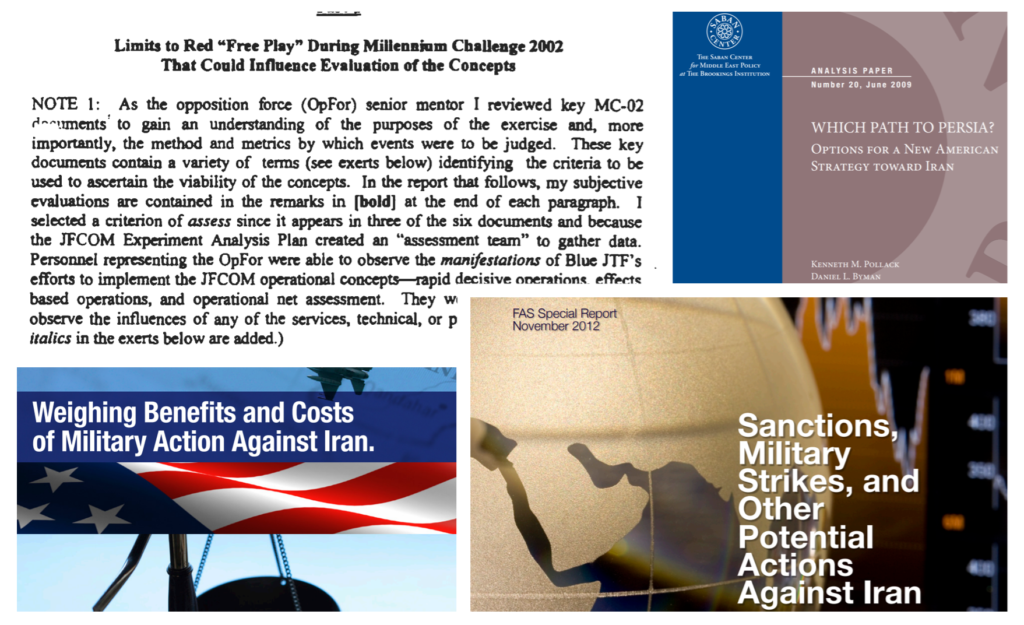
The first of these simulations came in 2002 and the results were sobering, to put it mildly. Only declassified in 2024, the quarter-billion dollar “Millenium Challenge 2002” war game resulted in the defeat of the “blue” (U.S. forces) at the hands of the “red” enemy (Iran) in the Persian Gulf. “The surprise defeat triggered internal warnings that the U.S. military was vulnerable to low-tech warfare,” the Washington Post reported, as American naval forces were overwhelmed by anti-ship missiles, swarms of explosive-laden Iranian speed boats, disruption of traffic in the Gulf and other asymmetric tactics:
As a U.S. Navy carrier battle group entered the Persian Gulf, it came under surprise attack by adversaries launching missiles from commercial ships and radio-silent aircraft that quickly overwhelmed its missile defense systems. Nineteen U.S. ships, including the aircraft carrier, were destroyed and sunk within 10 minutes.
Fortunately for U.S. forces, this scenario was only a simulation in a massive, $250 million war game named Millennium Challenge 2002. After the unexpected and humbling “loss” in July 2002, military officials at Joint Forces Command in Norfolk paused the war game, “refloated” the ships and restarted the exercise. They also imposed limits on enemy tactics. After the restart, the U.S. forces defeated their adversaries in a more conventionally fought simulation.
“In real-world terms, it would have been the deadliest day in U.S. naval history,” Ynet News recounted earlier this year, “with tens of thousands of casualties. Inside the command centers, the reaction was disbelief.” The necessary and painful process of learning from the stunning result was soon underway for the American military.
Just two years later, however, another “tabletop” war game also produced disturbing results.
In the December 2004 issue of The Atlantic, James Fallows asked, “Will Iran Be Next?” Less than 24 months after the U.S. invasion of Iraq, Fallows assembled a bipartisan collection of “soldiers, spies and diplomats” to be a national security “Principals Committee” to advise the President during a hypothetical crisis involving the Iranian nuclear program. Imagining that Tehran would refuse to meet a deadline to allow IAEA inspectors to visit its nuclear facilities as its enrichment program expanded, the Principals Committee had to decide what policy to recommend to the “president.”
Even with U.S. forces next door in Iraq, the military, political and economic consequences from any scenario they considered were too prohibitive. Under the guidance of retired Air Force Colonel Sam Gardiner, unilateral Israeli strikes, an American bombing campaign or a full-fledged war to topple the Islamic Republic all seemed unpalatable. As Microsoft Copilot summed up the findings:
The Atlantic’s simulation—designed by war‑gaming expert Sam Gardiner and played by former senior U.S. officials—found that no plausible U.S. military strike could stop Iran’s nuclear program, and that every military option produced outcomes worse than the status quo. The game repeatedly drove participants toward the same conclusion: military action would trigger uncontrollable escalation, strengthen Iran’s hardliners, and fail to achieve U.S. objectives.
“According to our panelists, he [the President] should understand that he cannot prudently order an attack on Iran, “Fallows wrote. “But his chances of negotiating his way out of the situation will be greater if the Iranians don't know that.” Gardiner ended the exercise with this lament:
“After all this effort, I am left with two simple sentences for policymakers," Sam Gardiner said of his exercise. "You have no military solution for the issues of Iran. And you have to make diplomacy work."
All that said, from an American perspective the situation improved over the intervening years. For its part, the CIA in a 2007 National Intelligence Estimate (NIE) controversially concluded that Iran had abandoned its nuclear weaponization program in 2003, providing Washington with more time if not more options. New U.S. weapons enhanced the Navy’s ability to protect its vessels, while the development of the 30,000 pound GBU-57 “massive ordinance penetrator” (MOP) capable of destroying underground targets like those at Natanz and Fordow. And while the drawdown of U.S. forces in Iraq removed the vulnerability of Americans there, the post-10/7 Israeli campaigns against Hamas, Hezbollah and Iranian air defenses left the regime in Tehran much weakened.
But as the debate over the American response to the Iranian nuclear program heated up during Barack Obama’s second term, new analyses offered similarly grim assessment of the global impact of military action. In 2009, the Brookings Institute delivered a report (“Which Path to Persia: Options for a New American Strategy Towards Iran”) which laid out several alternatives approaches to Tehran and its ambitions. Three years later, a study published by the Federation of American Scientists (FAS) sought to gauge the worldwide economic consequences of different American options, including ““(1) financial market losses, (2) oil price increases, (3) military costs and other expenditures to provide security, (4) damage to infrastructure resulting from conflict, and (5) other global economic costs.” The numbers were jaw-dropping. As ThinkProgress explained in November 2012:
A full-scale U.S. invasion of Iran could cost the global economy $1.7 trillion, according to the Federation of American Scientists, a nonpartisan think tank which released a report on Friday detailing the estimated costs of different approaches, including military strikes, to solving the Iranian nuclear issue. A “bombing campaign” could cost $1.2 trillion. If the U.S. decided to go about striking Iran’s nuclear sites “surgically,” it’d still cost the global economy more than $700 billion.
Not surprisingly, the group found that a diplomatic approach would be one of the least expensive ways to solve the issue. A continued, strengthened sanctions push could cost the global economy about $64 billion. If the U.S. decided to “isolate” and “blockade” the Iranian oil industry it could bring the cost $325 billion. The most frugal option, at an estimated $60 billion, would be to “de-escalate” with the U.S. unilaterally taking “steps to show that the United States is willing to make concessions.”
That search for the least bad approach to Iran followed on the heels of another bipartisan group of national security and foreign policy leaders convened in 2012 by the Iran Project at Columbia University. Their analysis (“Weighing the Costs and Benefits of Military Action Against Iran”) suggested nothing short of a full invasion and conquest of Iran could topple the regime and halt its nuclear program. Again, the costs—military, economic and political—would be staggering:
The report — whose signatories include Brent Scowcroft, ret. Adm. William Fallon, former Republican senator Chuck Hagel, ret. Gen. Anthony Zinni and former Amb. Thomas Pickering — concludes that a unilateral Israeli attack would set back the Iranian nuclear program by only 2 years and an American attack by 4 years. But if the objective is “ensuring that Iran never acquires a nuclear bomb,” the U.S. “would need to conduct a significantly expanded air and sea war over a prolonged period of time, likely several years.” In order to achieve regime change, the report says, “the occupation of Iran would require a commitment of resources and personnel greater than what the U.S. has expended over the past 10 years in the Iraq and Afghanistan wars combined.”
While the report notes that an attack would yield some benefits — such as damaging Iran’s nuclear and military facilities and demonstrating U.S. seriousness in preventing Iran from obtaining nuclear weapons — costs could include Iranian counter-attacks against Israel and American interests, a breakdown of the international coalition against Iran and the “increased likelihood of Iran becoming” a nuclear armed state. A sustained conflict “would boost the price of oil and further disrupt an already fragile world economy,” “could further alienate Muslims and others worldwide,” and likely “unify the [Iranian] population behind the government than to generate resistance.”
It’s no wonder the authors concluded with this warning: “Serious costs to U.S. interests would also be felt over the longer term, we believe, with problematic consequences for global and regional stability, including economic stability. A dynamic of escalation, action, and counteraction could produce serious unintended consequences that would significantly increase all of these costs and lead, potentially, to all-out regional war.”
Which brings us to Donald Trump’s little “excursion” in Iraq. In 2018, Trump tore up the Joint Comprehensive Plan of Action (JCPOA) negotiated by the Obama administration in 2015. That successful agreement led to 97% of Iran’s enriched uranium being removed from the country while two-thirds of centrifuges were dismantled, all under the watchful eye of IAEA inspectors. President Trump’s reckless first-term policy meant that the U.S. would be forced to either negotiate a new deal, launch a military campaign to remove the renewed Iranian nuclear threat or simply accept a nuclear regime in Tehran. In order strikes last June and again two weeks ago, Trump made his choice to attempt regime and the destruction of a nuclear program that, short of occupation, can be reconstituted over time. The results—closure of the Straits of Hormuz, skyrocketing gas prices, global shortages of fuel, liquid natural gas, fertilizer and other petroleum-based products—are as dire as they were predictable. Meanwhile, the United States is burning through munitions, diverting essential air defense systems to the Middle East, facing a regional conflict and entertaining the prospect of dispatching ground troops to secure Iran’s enriched uranium stockpiles, all while weakening its deterrent against its greatest challenger, China.
Most observers would call America’s current predicament dangerous at best and disastrous at worst. But Donald Trump has another description for his war of choice with no clear end in sight. “We’ve already won, but we haven’t won enough.”