Marco Rubio Redefines Religious Freedom as Christian Proselytization
The United States has marked International Religious Freedom Day every October 27th since President Bill Clinton signed the International Religious Freedom Act into law in 1998. It is altogether fitting that we do so. After all, as President Clinton explained upon signing the Act, “The United States was founded on the right to worship freely and on respect for the right of others to worship as they believe.” That fundamental American value is enshrined in the first clause of the first sentence of the First Amendment to the Constitution which declares “Congress shall make no law respecting an establishment of religion, or prohibiting the free exercise thereof.”
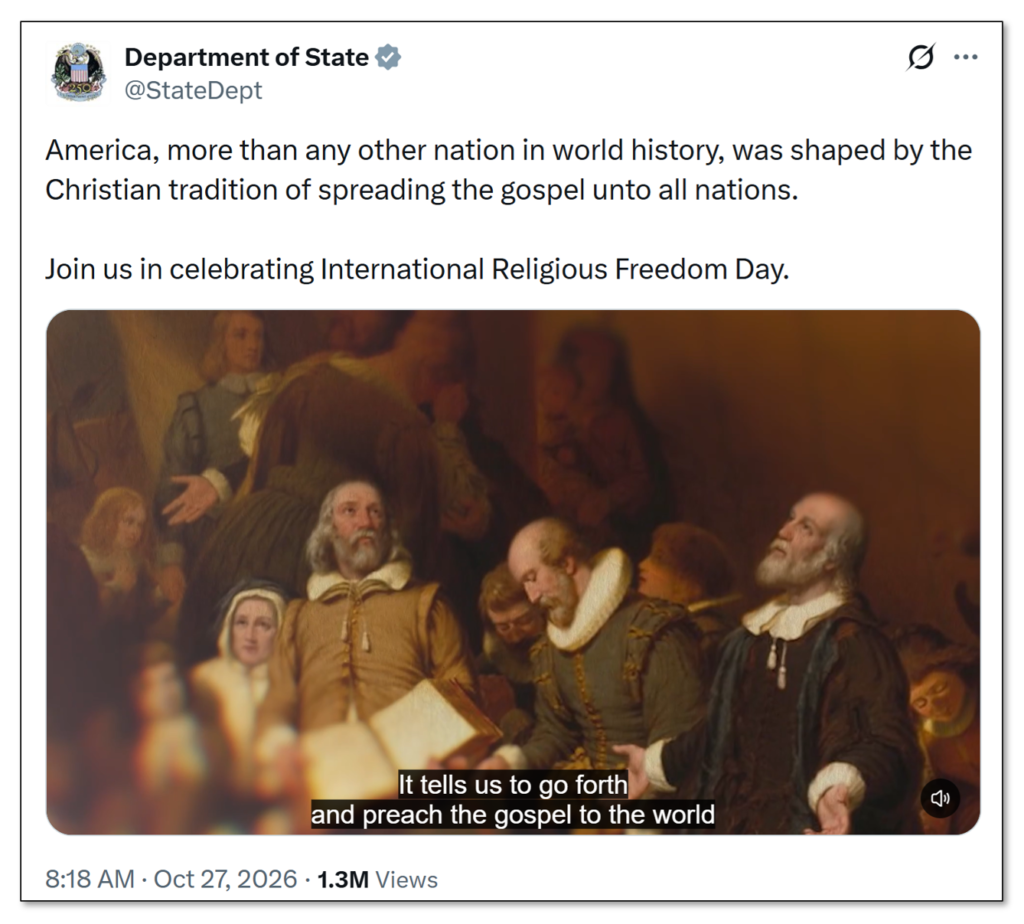
This year, Secretary of State Marco Rubio turned 250 years of American commitment to the freedom of worship on its head. As Rubio tells it in a video distributed by the State Department on X, supporting religious freedom abroad for the Trump administration now means preaching the Christian gospel:
Our faith calls us outwards into the limitless darkness of the unknown. It tells us to go forth and preach the gospel to the world as a witness to all nations, unto the ends of the earth. From that command came America. Our nation, more than any other nation in world history, was shaped by the Christian idea. This is who we are. And from the beginning, we have carried the belief that our country represents something new in the world. But the soul of our nation has always been rooted in an ancient faith.
The State Department’s X feed summed up Rubio’s perversion of religious freedom this way:
America, more than any other nation in world history, was shaped by the Christian tradition of spreading the gospel unto all nations.
Join us in celebrating International Religious Freedom Day.
Secretary Rubio is utterly and dangerously wrong. His evangelical mission for America is not “who we are.” The text and history of the Declaration of Independence and the United States Constitution proclaim the exact opposite.
When Thomas Jefferson wrote “all men are created equal,” he didn’t limit that equality only to those who held certain religious views, ideologies or values. As he explained the Constitution’s First Amendment to the Danbury Baptists who in 1802 had written President Jefferson about their persecution in Connecticut:
Believing with you that religion is a matter which lies solely between man & his god, that he owes account to none other for his faith or his worship, that the legitimate powers of government reach actions only and not opinions, I contemplate with sovereign reverence that act of the whole American people which declared that their legislature should "make no law respecting an establishment of religion, or prohibiting the free exercise thereof;" thus building a wall of eternal separation between Church & State.
In 1821, Jefferson similarly laid out the meaning of the Virginia Statute of Religious Liberty. Virginia rejected the language about “Jesus Christ, the holy author of our religion” in its preamble. This, he explained, was “proof that they meant to comprehend, within the mantle of its protection, the Jew and the Gentile, the Christian and Mahometan, the Hindoo, and Infidel of every denomination.”
That is certainly the understanding of the United States Commission on International Religious Freedom (USCIRF) established by the 1998 bill signed by President Clinton. “Freedom of religion or belief is an expansive right that includes the freedoms of thought, conscience, expression, association, and assembly,” USCIRF details in its definition, “While religious freedom is America’s first freedom, it also is a core human right international law and treaty recognize; a necessary component of U.S. foreign policy and America’s commitment to defending democracy and freedom globally; and a vital element of national security, critical to ensuring a more peaceful, prosperous, and stable world.”
President Clinton echoed that mission in his signing statement:
When we promote religious freedom we also promote freedom of expression, conscience, and association, and other human rights. This Act is not directed against any one country or religious faith. Indeed, this Act will serve to promote the religious freedom of people of all backgrounds, whether Muslim, Christian, Jewish, Buddhist, Hindu, Taoist, or any other faith.
Clinton’s successor, Republican George W. Bush, agreed. His Secretary of State Colin Powell articulated the same message on September 15, 2004, when delivered the sixth annual Report on International Religious Freedom:
America's commitment to religious liberty is older than our nation itself. The men and women who journeyed to this new world believed that one's conscience was sacred ground upon which government cannot tread.
Those courageous settlers cherished religious freedom as one of many inalienable rights inherent in human nature itself, one of those rights that formed the moral foundation of all just political orders.
As President Bush has said, religious liberty is the first freedom of the human soul. America stands for that freedom in our own country, and we speak for that freedom throughout the world.
With the release of today's report, we reaffirm the universal spirit of our nation's founding. We reaffirm that government exists to protect human rights, not to restrict them; and we stand in solidarity with people everywhere who wish to worship without coercion.
Put another way, religious freedom is America’s gospel.
President Bush voiced that same commitment during a July 14, 2008, speech commemorating the 10th anniversary of the signing of the International Religious Freedom Act:
This legislation that we commemorate today builds on a tradition that defined our nation. After all, when the Founding Fathers adopted the Bill of Rights, the very first liberty they enshrined was the freedom of religion. They recognized that the most basic freedom a man can have is the right to worship his own God as he sees fit.
Bush went on to decry infringements against religious liberty around the world. He spoke out against the imprisonment of the Muslim chief mufti in Turkmenistan, against attacks on Buddhist monks in Burma, against persecution of Christians in Eritrea and North Korea, and against the Uighur Muslims in China. Bush’s defense of “the most basic freedom a man can have” is a far cry from Marco Rubio’s “Christian tradition of spreading the gospel unto all nations.”
Secretary Rubio’s crusade is an insult to the core American value of religious freedom. It is as old as the nation itself and as clear as the text of the Constitution. But in President Donald Trump’s administration, the coward Marco Rubio fears he doesn’t have to freedom to defend it.